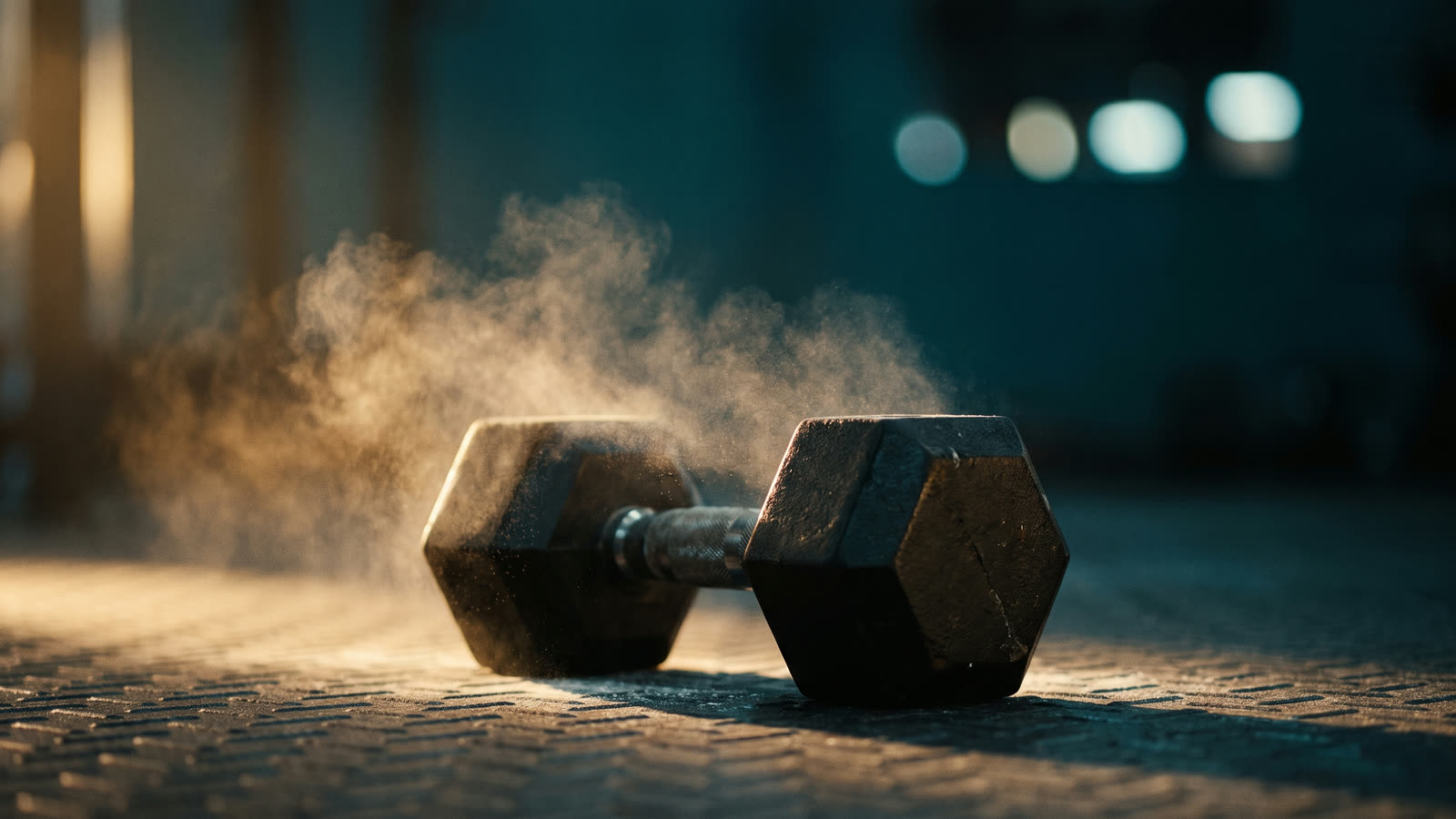
A pair of dumbbells on the floor of a spare room is enough equipment to get stronger for a long time. Not forever, and not for everything, but for most people reading this, the limit for the next year is not the gear. It's a plan you'll actually repeat.
This is that plan. Three days a week, full body, six movements a session, forty minutes. It assumes a pair of adjustable dumbbells, or two or three fixed pairs, and nothing else. No dumbbells yet? Start with the bodyweight version. If you've never lifted at all, the first four weeks explains the ideas behind every rule here; this page is the program itself.
Why dumbbells alone work
The worry is that dumbbells are too light to do anything. The research says otherwise: a review of 21 studies found that light and heavy loads built similar amounts of muscle when sets were taken to failure, with heavy loads better only for one-rep-max strength.1 A dumbbell you can press twelve times is not a lesser tool than a barbell you can press five times; it's a different rep range doing the same job. (Lift by lift: dumbbell vs barbell.) And the dose doesn't need to be large: the American College of Sports Medicine's 2026 position stand says even "minimal doses" of lifting bring substantial strength gains.2
What dumbbells give you that a gym doesn't: no commute, no waiting for a rack, and no reason the session can't happen at six in the morning. What they don't give you is unlimited load, which is why the last section is about what to do when a pair runs out.
What you need
- Dumbbells. One adjustable pair that goes from light to around half your body weight each is ideal. Three fixed pairs (light, medium, heavy) also work; you'll use the light pair for shoulders and the heavy pair for legs and hinges.
- Something to lie on. A bench is best. The floor works for presses (a floor press is a real exercise) and a sturdy chair works for step-ups and supported rows.
- A place to write. Weight and reps for every set, in your phone or a notebook (a layout). The plan only progresses if you know what you did last time.
- Forty minutes, three times a week, on days you can repeat. Monday, Wednesday, Friday is the classic; any three non-consecutive days are fine.
The plan: three days, full body
Every session has the same six slots in the same order: a squat, a hinge, a push, a pull, a shoulder move, and a core move. The exercises rotate across the three days so each slot gets two variations a week and nothing gets stale. (Squat form and deadlift form cover the first two slots step by step.)
Day A
- Goblet squat, one dumbbell held at the chest
- Romanian deadlift, two dumbbells
- Floor press or bench press, two dumbbells
- One-arm row, hand on a bench or chair
- Overhead press, standing or seated
- Dead bug, bodyweight, slow
Day B
- Reverse lunge, dumbbells at your sides
- Glute bridge or hip thrust, one dumbbell on the hips
- Push-up (on an incline if needed) or incline dumbbell press
- Bent-over row, two dumbbells
- Lateral raise, light dumbbells
- Plank, as long as the position stays good
Day C
- Step-up onto a chair or box, dumbbells at your sides
- Single-leg Romanian deadlift, one dumbbell, hold something for balance
- Dumbbell bench or floor press, slower on the way down
- Chest-supported row, lying face down on an incline bench, or a one-arm row again
- Arnold press or overhead press
- Suitcase carry, one heavy dumbbell, walk the room, switch hands
Sets and reps for everything: two sets of eight to twelve in the first two weeks, three sets from week three. Rest about ninety seconds between sets, longer on the squats and hinges if you need it. A session is thirty-five to forty-five minutes.
How heavy: too easy is correct
Every set stops with three or four reps still in you. (Picking that weight: how much weight to lift.) If you finish and think "I could have done more", that's the plan working. There are two reasons to train this far from failure when you're new. First, you don't need to reach failure to grow; the review above compared loads at failure, but the strength gains and the muscle gains both show up well before it. Second, beginners are the people least able to judge how many reps they have left: research keeps finding that lifters underestimate how many reps remain, especially when a set is far from failure,3 and that the skill improves with experience.4 So leave more in reserve than feels necessary. Your estimate will get better by week four, and the weights will go up anyway.
Expect to be sore after the first two sessions. That's common when a kind of exercise is new to you, and the standard advice is to ease into it over a week or two rather than push through.5 Week one is light on purpose.
The four-week rule
Week 1: learn the movements
Two sets each, weights that feel almost silly. The job is to leave each session knowing what every exercise feels like and having written every set down.
Week 2: add the smallest amount
Same exercises. Wherever you hit twelve reps with three or four to spare, go up one notch on the adjustable pair or move to the next fixed pair. Where you didn't, repeat the weight.
Week 3: a third set
Three sets of everything. Sessions get about ten minutes longer. This is the only change this week.
Week 4: notice it
By now most lifts have gone up at least twice and the sessions run on their own. From here the rule is simple: add a notch or a rep whenever the top of the range feels easy, and nothing else. Progressive overload, explained covers the five ways to progress when weight alone stops being the lever.
Over forty, or coming back after years
The plan is the same; the ramp is slower. Take an extra week at two sets, spend five minutes walking and swinging your arms before the first set, and treat the "three or four reps left" rule as a floor, not a target. The World Health Organization's guideline for adults is muscle-strengthening work on two or more days a week,6 and it applies at sixty the same as at twenty-five; the difference is mostly how long the first month takes. If you have an injury, a medical condition or a medical question, talk to your doctor before you start. I'm a fitness coach, not a doctor.
When the dumbbells run out
Legs and hinges run out first: a goblet squat with your heaviest dumbbell stops being hard long before a press does. In order, the fixes are:
- Slow the lowering phase to three or four seconds. Same weight, harder set.
- Go single-leg. Step-ups, reverse lunges and single-leg deadlifts double the load on the working leg without a heavier dumbbell.
- Add reps up to fifteen, then twenty, before you buy anything.
- Buy the next pair, or a heavier adjustable set.
- Join a gym for legs and keep the dumbbells for everything else. One gym day a week plus two home days is a plan you can run for years. (A gym leg day, written out.)
Five rules that keep this going
- Same plan for at least eight weeks. Rotate the exercises inside the slots if you must; don't rewrite the structure.
- Write everything down. The plan is the logbook.
- Add the smallest amount. One notch, one rep. Never a big jump because you felt good.
- Never miss twice. One missed session is life. Two in a row is the start of quitting.
- If it hurts, stop and ask. Sharp pain is not soreness.
If you want it written for your week
This is a plan for everyone, which means it isn't written for your Tuesdays. Coaching is the version where the exercises fit the equipment you actually own, the days fit the week you actually have, and someone reads the logbook every week and changes what needs changing. Coaching for a week that doesn't hold still explains how that works, and apply tells me about your week. Otherwise: set the dumbbells to too light, book three days, and do Day A.
General education only, not medical advice. If you have a medical condition, are pregnant, or take medication, check with your doctor before changing how you train or eat.
Sources
- Schoenfeld BJ, Grgic J, Ogborn D, Krieger JW. Strength and hypertrophy adaptations between low- vs. high-load resistance training: a systematic review and meta-analysis. Journal of Strength and Conditioning Research, 2017. https://pubmed.ncbi.nlm.nih.gov/28834797/ (accessed October 12, 2026).
- Currier BS, D'Souza AC, Singh MAF, et al. American College of Sports Medicine position stand. Resistance training prescription for muscle function, hypertrophy, and physical performance in healthy adults: an overview of reviews. Medicine & Science in Sports & Exercise, 2026. https://pmc.ncbi.nlm.nih.gov/articles/PMC12965823/ (accessed October 11, 2026).
- Halperin I, Malleron T, Har-Nir I, et al. Accuracy in predicting repetitions to task failure in resistance exercise: a scoping review and exploratory meta-analysis. Sports Medicine, 2022. https://pubmed.ncbi.nlm.nih.gov/34542869/ (accessed October 11, 2026).
- Steele J, Endres A, Fisher J, et al. Ability to predict repetitions to momentary failure is not perfectly accurate, though improves with resistance training experience. PeerJ, 2017. https://pmc.ncbi.nlm.nih.gov/articles/PMC5712461/ (accessed October 11, 2026).
- Cheung K, Hume P, Maxwell L. Delayed onset muscle soreness: treatment strategies and performance factors. Sports Medicine, 2003. https://pubmed.ncbi.nlm.nih.gov/12617692/ (accessed October 18, 2026).
- Bull FC, Al-Ansari SS, Biddle S, et al. World Health Organization 2020 guidelines on physical activity and sedentary behaviour. British Journal of Sports Medicine, 2020. https://pmc.ncbi.nlm.nih.gov/articles/PMC7719906/ (accessed October 11, 2026).