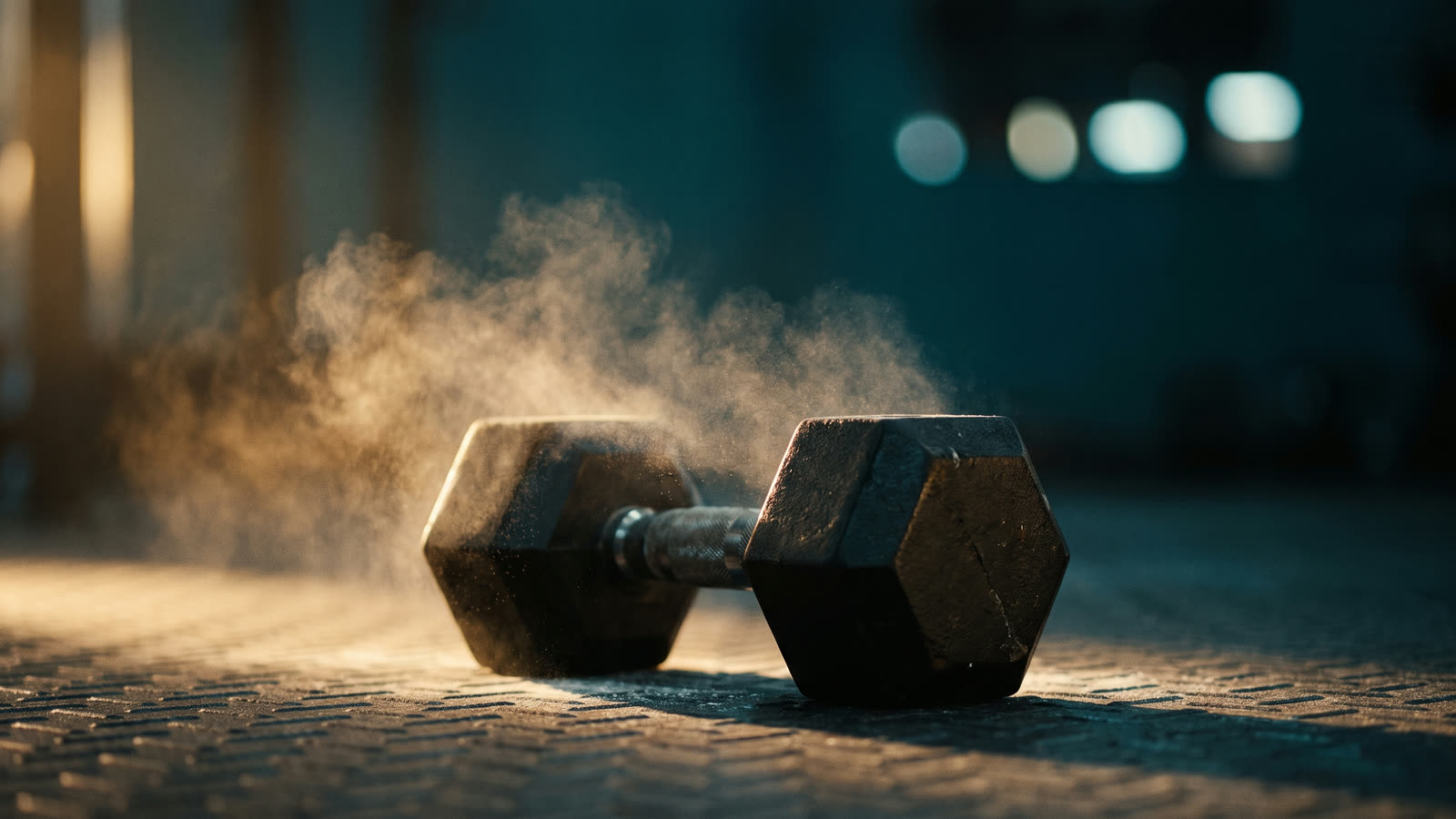
A chest fly moves only at the shoulder. Your arms stay nearly straight, with one fixed bend at the elbow, and swing together in front of your chest like you're hugging a barrel. A press moves the elbow and the shoulder together; the fly takes the elbow out of it, so the work goes into bringing your arms together across your chest.
This page covers the three common versions (dumbbells, cables and the fly machine), the arc and how deep the stretch should go, what the research says about the fly against the bench press, the faults, and where it goes in a week. The whole chest plan is on the chest workout, and the presses it sits behind are on bench press form and the incline press.
Dumbbell, cable and machine fly
Dumbbell fly
- Lie on a flat bench, feet flat, and press a dumbbell in each hand up over your chest, palms facing each other.
- Soften the elbows into a slight bend and keep that exact bend for the whole set.
- Open your arms in a wide arc, lowering the dumbbells out to your sides until you feel a stretch across your chest.
- Bring them back up along the same arc until they're over your chest again, just short of touching.
Cable fly
- Set both pulleys at about shoulder height, a handle in each hand, and step forward into a split stance.
- Start with your arms open, elbows slightly bent, a light stretch across the chest.
- Bring your hands together in front of your chest, then let them open back to the stretch slowly.
Pulleys set high, pulling down and in, or low, pulling up and in, change the angle of the arc. The research on which part of the chest each height favors is thin, so pick the one that feels strongest and keep it long enough to add weight.
Machine fly (pec deck)
Set the seat so the handles sit at chest height, sit with your back flat against the pad, and bring the handles together in front of you, then back to the stretch. The machine fixes the arc, which makes it the easiest version to learn and to load.
The arc and the stretch
Each version loads the arc differently. With dumbbells, the hardest point is near the bottom, where your arms are out wide: a study of the fly describes its sticking point as early in the lift, "due to the high leverage created by the arms in this position."1 At the top, with the weights over your shoulders, there's almost nothing to push. A cable pulls from the side, so the load stays on as your hands come together. That's the practical case for using both: dumbbells for the stretched position, cables or the machine for the squeeze.
How deep? Open until you feel a stretch across the chest with your upper arms about level with your torso, and stop there. With dumbbells, that's already the hardest point of the rep.
Fly vs press: what the research says
- Activity. In 17 resistance-trained men, about five years into lifting, the bench press produced more chest, front-shoulder and triceps activity than a dumbbell fly across most of the rep. The authors' advice: both can go in a program, with the emphasis on the bench press.2 An older study of 12 college-age men and women found similar activity in the chest and the front of the shoulder across the barbell press, the dumbbell press and the dumbbell fly, though the fly kept the muscles working for less of each rep; its authors saw the fly as an auxiliary lift.3
- Growth. A fly on its own builds the chest. In 15 untrained young men who trained only on the fly machine for 12 weeks, the upper and lower chest both thickened, by 17 to 21%, and one set a session did about as well as three.4
- Strength. Pressing builds the press more. In an eight-week trial with the total work matched, 36 physically active men trained with only isolation exercises, a dumbbell fly among them, or only compound ones, such as the bench press. Bench press one-rep max rose 8.1% in the isolation group and 10.9% in the compound group.5
- Head to head for growth, the American College of Sports Medicine's 2026 position stand found too little data to say whether single-joint or multi-joint exercises build more muscle.6
So the press is the base and the fly is an extra: a real chest exercise that adds chest sets without adding more pressing. Most of these studies are small and mostly in men, and the growth trial was in beginners.
The common faults, and a fix for each
- Turning it into a press. The elbows bend more on the way down and straighten on the way up. Go lighter and hold one bend from the first rep to the last.
- Going too heavy. A heavy dumbbell drags the arms below the bench and forces the bend. Fly weights are light; pick one you can move 12 to 15 times.
- Dropping into the stretch. Lower in about two seconds and stop where the stretch starts, rather than bouncing out of the bottom.
- Shoulders rolling forward. Keep your shoulder blades back and down on the bench or the pad, and your chest up.
- Clanging the dumbbells together. There's no load up there. Stop just short of touching and start the next rep.
- Pushing through pain. Sharp pain is not soreness. Stop, and see a doctor or a physical therapist.
How it fits a chest day
After the presses. The American College of Sports Medicine's 2009 position stand advises putting multiple-joint exercises before single-joint ones in strength programs,7 and its 2026 stand found that exercise order didn't affect muscle growth.6 Order does change the reps: in 14 trained men who did five sets of the bench press and five of the machine fly, the total reps across the workout were about the same either way, but each exercise got more reps when it came first.8 So the fly goes last unless the fly is the lift you most want to improve.
- Two or three sets of 10 to 15, stopping with two or three reps still in you. (How to judge reps left.)
- Count them as chest sets. The 2026 stand found muscle growth was enhanced by ten or more sets per muscle group a week,6 and a hard set of a fly counts toward that like a set of a press.
- A day that works: a flat press, an incline press, then the fly, three sets each. The chest workout spreads that across the week.
- On a cable station, pair the cable fly with the seated cable row: a push and a pull, one set of each, then rest.
At home: a floor fly with dumbbells, where the floor sets the depth for you, or a band fly with a band anchored behind you at chest height. In 29 men and women, a band fly produced slightly less chest activity than a dumbbell fly with the loads matched to ten reps, and more activity in the front of the shoulder; the authors call bands a feasible alternative to dumbbells.1
If you'd rather not plan it alone
A fly is easy to add; deciding how many chest sets your week already has, and where the fly fits between your presses and the rest of your training, is the part a page can't do. Coaching is the version where your workouts are built around the days you actually have, and a weekly call looks at the week you just had and rebuilds the next one. Coaching to build muscle explains how that works, and here's how to apply. Otherwise: after your next press, do three slow sets of 12 on the fly machine.
General education only, not medical advice. If you have a medical condition, are pregnant, or take medication, check with your doctor before changing how you train or eat.
Sources
- Bergquist R, Iversen VM, Mork PJ, et al. Muscle activity in upper-body single-joint resistance exercises with elastic resistance bands vs. free weights. Journal of Human Kinetics, 2018. https://pmc.ncbi.nlm.nih.gov/articles/PMC5873332/ (accessed October 24, 2026).
- Solstad TE, Andersen V, Shaw M, et al. A comparison of muscle activation between barbell bench press and dumbbell flyes in resistance-trained males. Journal of Sports Science & Medicine, 2020. https://pubmed.ncbi.nlm.nih.gov/33239937/ (accessed October 22, 2026).
- Welsch EA, Bird M, Mayhew JL. Electromyographic activity of the pectoralis major and anterior deltoid muscles during three upper-body lifts. Journal of Strength and Conditioning Research, 2005. https://pubmed.ncbi.nlm.nih.gov/15903389/ (accessed October 24, 2026).
- Pinto MD, Ughini C, Nunes JP, et al. Pectoralis clavicular and sternocostal thicknesses increase similarly in response to one and three sets of pec deck resistance training in untrained young men. Journal of Strength and Conditioning Research, 2025. https://pubmed.ncbi.nlm.nih.gov/40266636/ (accessed October 24, 2026).
- Paoli A, Gentil P, Moro T, Marcolin G, Bianco A. Resistance training with single vs. multi-joint exercises at equal total load volume: effects on body composition, cardiorespiratory fitness, and muscle strength. Frontiers in Physiology, 2017. https://pmc.ncbi.nlm.nih.gov/articles/PMC5744434/ (accessed October 22, 2026).
- Currier BS, D'Souza AC, Singh MAF, et al. American College of Sports Medicine position stand. Resistance training prescription for muscle function, hypertrophy, and physical performance in healthy adults: an overview of reviews. Medicine & Science in Sports & Exercise, 2026. https://pmc.ncbi.nlm.nih.gov/articles/PMC12965823/ (accessed October 11, 2026).
- American College of Sports Medicine. Position stand: progression models in resistance training for healthy adults. Medicine & Science in Sports & Exercise, 2009. https://pubmed.ncbi.nlm.nih.gov/19204579/ (accessed October 12, 2026).
- Senna GW, Willardson JM, Scudese E, et al. Multi- to single-joint or the reverse exercise order does not affect pectoralis major workout performance. Journal of Human Kinetics, 2019. https://pmc.ncbi.nlm.nih.gov/articles/PMC6458580/ (accessed October 24, 2026).