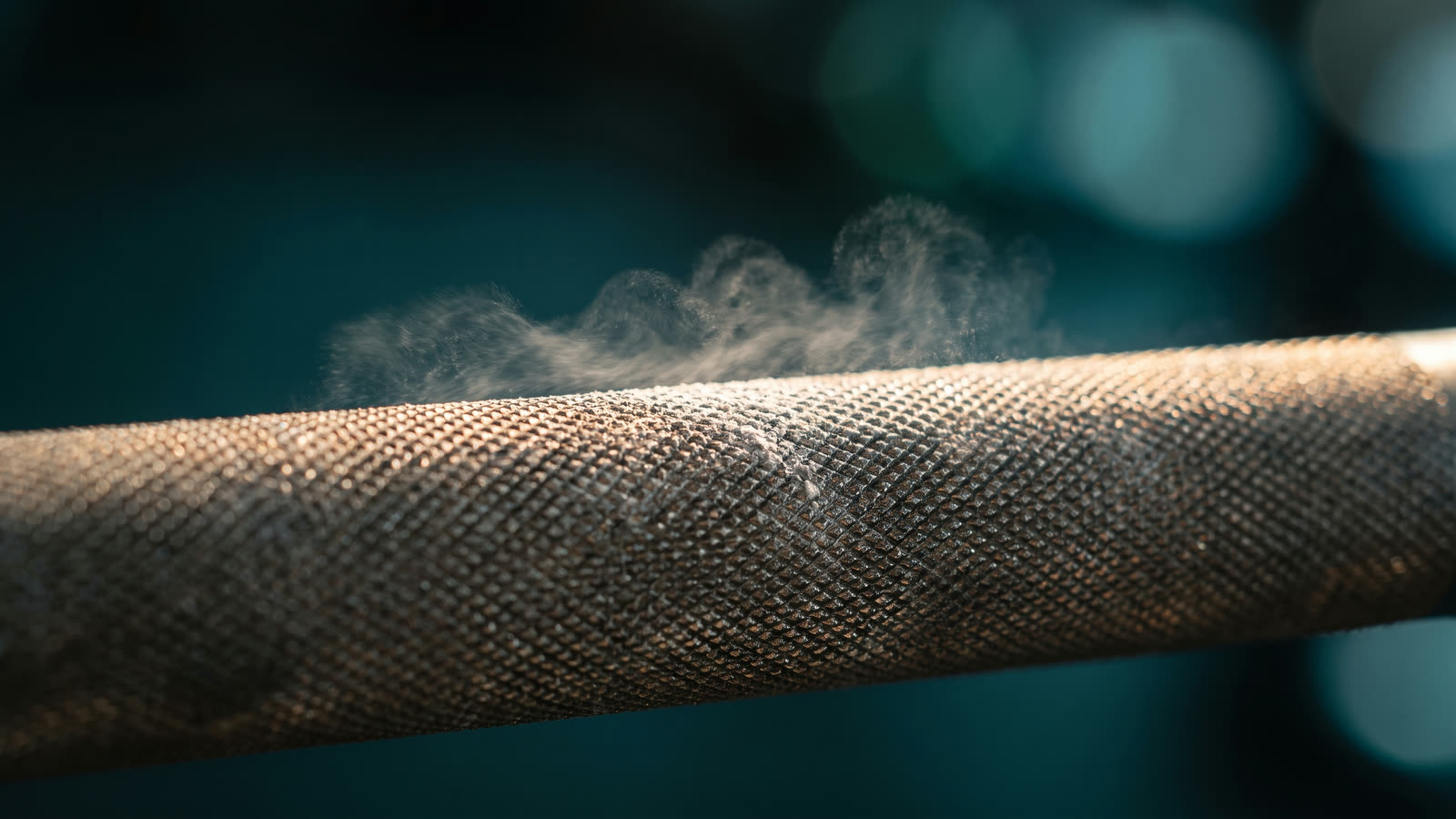
A front squat is a barbell squat with the bar resting across the front of your shoulders instead of your upper back. Because the weight sits in front, you stay more upright to keep it over your feet, and you can't hold as much as on your back. The squat itself follows the same checkpoints; the new skill is the rack position.
This page covers the three ways to hold the bar, the setup, depth, the faults, the dumbbell version, and how the front squat compares with the back squat. The back squat and the full set of squat checkpoints are on squat form; the one-dumbbell version of a front-loaded squat is the goblet squat.
The rack position: three ways to hold the bar
In every version the bar sits on the front of your shoulders, in the groove between the shoulder muscle and the collarbone, close to your throat. Your hands keep it there; your shoulders carry it.
| Hold | How | Good for |
|---|---|---|
| Clean grip | Hands just outside your shoulders, fingertips under the bar, elbows pushed forward and up | The most secure hold, if your wrists and upper back allow it |
| Cross-arm | Arms crossed in front, each hand resting on top of the bar over the opposite shoulder, elbows up | Stiff wrists; easier to learn |
| Straps | A lifting strap looped around the bar on each side, held in your fists, elbows up | Halfway between the two: a clean-grip position with less wrist bend |
| Harness | A shoulder harness that hooks the bar or the plates | When no hold works yet, or the arms tire before the legs |
Whatever the hold, the elbows are the key: if they drop, the bar rolls forward off your shoulders. A clean grip doesn't need a full grip; two or three fingers under the bar is enough. It takes a few sessions of practice with an empty bar before the hold stops being the hard part.
How to set up and squat
- Set the bar at about upper-chest height in the rack.
- Step under it and take your hold, the bar in the groove at the front of your shoulders, elbows high.
- Stand it up and take two or three short steps back.
- Feet about shoulder-width apart, toes turned out a little.
- Breathe in and brace, before every rep.
- Sit straight down between your heels, knees travelling forward over your toes, torso upright, elbows staying up.
- Stand up by driving your elbows and chest up first, and breathe at the top.
The bar should travel in a straight line over the middle of your foot. Film a set from the side; if the bar drifts forward, your elbows are dropping or your hips are rising first.
How deep to go
As deep as you can keep the position: heels down, torso upright, elbows up. Full-range training built more strength and more lower-body muscle than partial reps in a 2021 meta-analysis of 16 studies.1 A practical target is thighs at least level with the floor. The research on depth is covered in full on squat form.
Front squat vs back squat: what the research says
- Similar overall muscle activity. In 15 healthy trained people, the front squat was as effective as the back squat in overall muscle recruitment; bar position didn't change muscle activity.2 In 13 resistance-trained women each lifting a 10-rep max, glute, hamstring and outer-thigh activity didn't differ between front, full and parallel squats. The authors add that despite requiring lighter loads, the front squat may give a similar training stimulus.3
- A more upright torso. In 12 young adults squatting their maximum, the back squat showed significantly more trunk lean, with no difference in how the knees moved. The front squat produced more activity in the inner front-thigh muscle (vastus medialis), and the back squat more in one hamstring on the way up.4 In 18 adults (10 men, 8 women), placing the load further forward reduced forward lean and pelvic tilt, while hip, knee and ankle demands stayed generally similar.5
- Hips or thighs, depending on how you match the weight. In 11 college athletes, with the same weight on the bar, the back squat put more demand on the hip extensors and the front squat more on the front of the thigh at the heaviest load tested. Matched to each lift's own maximum instead, the authors' estimates put the demand on the front of the thigh about the same.6
- Some differences in experienced lifters. In 10 male competitive bodybuilders at 80% of their max, the front squat produced more glute activity on the way down than back squats at several depths and stances, and more activity in one front-thigh muscle (rectus femoris) on the way up than the full back squat.7
So the front squat isn't a lesser squat or a quad-only one. It trains the same muscles with a lighter bar and a more upright torso. A PubMed search for this page found no training trial comparing the two over weeks, so the choice is practical: the back squat moves more weight; the front squat suits people who find it easier to stay upright and reach depth with the load in front. Plenty of plans use both, the back squat as the main lift and the front squat on a second leg day.
Front squat with dumbbells
Hold a dumbbell in each hand with one end resting on the front of each shoulder, elbows up and forward, and squat with the same checkpoints. It's the home version of the barbell lift. With one weight, the goblet squat does the same job: the load in front, the torso upright. Either runs out when your arms or upper back tire before your legs; slow the lowering or pause at the bottom before you look for a barbell.
Alternatives
- The rack hold won't work yet: a goblet squat, or a front squat with straps or a harness.
- One leg at a time: the Bulgarian split squat, which also keeps the torso fairly upright.
- A machine: the leg press, or a bar fixed on rails, which removes the balance but keeps the squat pattern.
- The bar on your back: the back squat on squat form.
The common faults, and a fix for each
- Elbows dropping. The bar rolls forward and the torso follows. Drive the elbows up at the start of every rep, and lighten the bar until they stay.
- Holding the bar with the hands. The wrists bend back and the bar wanders. Let the shoulders carry it; the fingers only keep it in place, or switch to the cross-arm hold or straps.
- The hips rising first. The squat turns into a lean-over and the bar slides forward. Lead the way up with your chest and elbows.
- Heels lifting. Sit down between your heels rather than forward.
- Depth that shrinks as the weight climbs. Keep the depth and let the weight wait.
- Squatting through pain. Sharp pain is not soreness. Stop, and see a doctor or a physical therapist.
Sets, reps and where it goes
- Three sets of 5 to 10, stopping with two or three reps in reserve. The rack position tends to fail before the legs on long sets, which is why lower reps are common. (How to judge reps left.)
- First in the session, as the main squat of the day, or second after a back squat on a lighter day. The American College of Sports Medicine's 2026 position stand found that strength was enhanced by two to three sets and by doing an exercise at the beginning of a session.8
- Add weight in small steps. The front squat stalls on the hold; adding reps first often works better than adding plates. (Progressive overload covers how much.)
If you'd rather not plan it alone
The rack position is a few sessions of practice; deciding whether the front squat replaces your back squat or joins it, and how heavy each one should be, is the part a page can't do. Coaching is the version where your workouts are built around the days you actually have, and a weekly call looks at the week you just had and rebuilds the next one. Coaching to build muscle explains how that works, and here's how to apply. Otherwise: practice the rack hold with an empty bar, then do three sets of five at your next leg day.
General education only, not medical advice. If you have a medical condition, are pregnant, or take medication, check with your doctor before changing how you train or eat.
Sources
- Pallarés JG, Hernández-Belmonte A, Martínez-Cava A, et al. Effects of range of motion on resistance training adaptations: a systematic review and meta-analysis. Scandinavian Journal of Medicine & Science in Sports, 2021. https://pubmed.ncbi.nlm.nih.gov/34170576/ (accessed October 22, 2026).
- Gullett JC, Tillman MD, Gutierrez GM, Chow JW. A biomechanical comparison of back and front squats in healthy trained individuals. Journal of Strength and Conditioning Research, 2009. https://pubmed.ncbi.nlm.nih.gov/19002072/ (accessed October 22, 2026).
- Contreras B, Vigotsky AD, Schoenfeld BJ, et al. A comparison of gluteus maximus, biceps femoris, and vastus lateralis electromyography amplitude in the parallel, full, and front squat variations in resistance-trained females. Journal of Applied Biomechanics, 2016. https://pubmed.ncbi.nlm.nih.gov/26252837/ (accessed October 24, 2026).
- Yavuz HU, Erdağ D, Amca AM, Aritan S. Kinematic and EMG activities during front and back squat variations in maximum loads. Journal of Sports Sciences, 2015. https://pubmed.ncbi.nlm.nih.gov/25630691/ (accessed October 24, 2026).
- Goršič M, Rochelle LE, Layer JS, et al. Biomechanical comparisons of back and front squats with a straight bar and four squats with a transformer bar. Sports Biomechanics, 2024. https://pubmed.ncbi.nlm.nih.gov/33161870/ (accessed October 24, 2026).
- Krzyszkowski J, Kipp K. Load-dependent mechanical demands of the lower extremity during the back and front squat. Journal of Sports Sciences, 2020. https://pubmed.ncbi.nlm.nih.gov/32544021/ (accessed October 24, 2026).
- Coratella G, Tornatore G, Caccavale F, et al. The activation of gluteal, thigh, and lower back muscles in different squat variations performed by competitive bodybuilders: implications for resistance training. International Journal of Environmental Research and Public Health, 2021. https://pubmed.ncbi.nlm.nih.gov/33477561/ (accessed October 24, 2026).
- Currier BS, D'Souza AC, Singh MAF, et al. American College of Sports Medicine position stand. Resistance training prescription for muscle function, hypertrophy, and physical performance in healthy adults: an overview of reviews. Medicine & Science in Sports & Exercise, 2026. https://pmc.ncbi.nlm.nih.gov/articles/PMC12965823/ (accessed October 11, 2026).