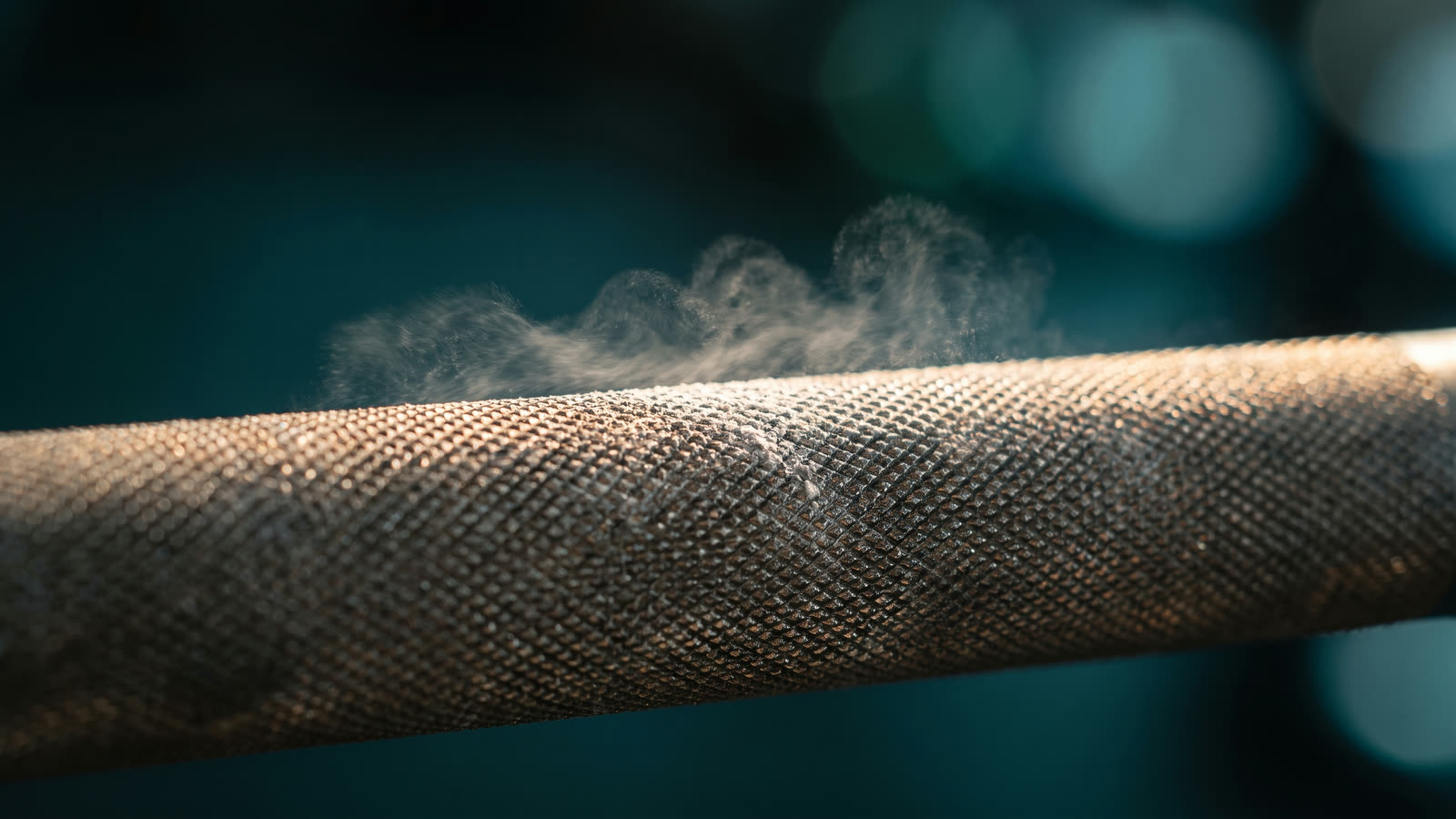
A good morning is a hip hinge with a barbell across your upper back. With your knees softly bent, you push your hips back and bow your torso forward, then stand back up. It's the same movement as the Romanian deadlift with the weight in a different place, and it's an accessory: a second hinge after your main lifts, not a lift to test your max on.
This page covers the setup, where the bar sits and how far to bend, what the good morning trains, the dumbbell, band and bodyweight versions, how it compares with the RDL, sets and reps, and the faults. The hinge itself, learned with a broomstick, is in deadlift form.
How to do a good morning
- Set the bar in a rack at about upper-chest height, as you would for a squat.
- Get under it. The bar sits across the top of your shoulders, slightly higher than it sits for a back squat.1 Hands just outside your shoulders, pulling the bar into your back.
- Stand it up and step back. Feet about shoulder-width apart, knees softly bent.
- Brace, then push your hips straight back. Your torso bows forward as your hips travel back, and your knees stay at the angle you set.
- Stop at the bottom: your torso close to parallel with the floor, or the backs of your thighs fully stretched, whichever comes first.
- Drive your hips forward to stand tall. That's one rep.
Keep your back in the position you set at the top, with your neck in line with it. The bow comes from your hips; when your hips stop moving back, the rep has reached its bottom.
Where the bar sits, and how far to bend
The bar goes on the muscle across the top of your shoulders, as in a high-bar squat, never on your neck. Pull it tight into your back so it can't roll. A safety squat bar, the kind with padded arms and handles in front, sits in the same place and frees your hands.
The range. A description of the lift in a 2015 study has the lifter bend forward from the hips until the torso is roughly parallel with the floor.1 Many people run out of stretch in the backs of their thighs before that; stop there. The range that counts is the one you reach with your back still in position, the same rule as the RDL. If your hamstrings stop you well short, hip mobility has a hinge check and the drills.
The load changes the lift. In 15 trained men doing single reps at 50% to 90% of their max, hamstring and back-muscle activity tended to rise with the weight. So did knee bend, and the estimated length of the hamstrings shrank as the bar got heavier.1 A heavy good morning drifts toward a squat. Keep the weight light enough that your knees stay where you set them.
What good mornings train
The hamstrings, the glutes and the muscles along your spine, which hold your position. For the hamstrings, the activity studies rank it below the deadlifts:
- In 12 weight-trained men, hamstring activity was highest in the RDL and the glute-ham raise, ahead of the leg curl and the good morning.2
- A 2021 review of 29 studies, 507 people aged 19 to 30, sorted exercises by type. For one hamstring muscle, the biceps femoris long head, good mornings averaged about 23% of a maximal contraction, against about 42% for deadlifts and about 49% for leg curls.3
- The glutes may be another matter. In a modelling study of eight women with at least a year of strength training, each lifting a bar of a quarter of her body weight, the glutes were most active in the good morning and in the front leg of the split squat, more than in the back squat.4
All three measured a single session, not growth. No training trial of the good morning turned up in a PubMed search for this page, so what it builds over weeks hasn't been tested on its own. Use it as a second hinge, not the first.
Dumbbell, band and bodyweight versions
| Version | How | When to use it |
|---|---|---|
| Barbell good morning | Bar across the top of your shoulders | The standard version, and the one you can load |
| Safety bar good morning | A safety squat bar, hands on the handles in front | If your gym has one |
| Dumbbell good morning | One dumbbell or kettlebell held against your chest, arms crossed over it | At home, or with a light load |
| Band good morning | Stand on a long band, the other end looped behind your shoulders | At home; the band gets harder as you stand up |
| Bodyweight good morning | Hands behind your head or a broomstick along your back | Learning the hinge, or a warm-up |
| Smith machine good morning | The bar runs on rails | Less to balance; the same hinge |
The broomstick drill in deadlift form is a bodyweight good morning, with the stick touching your head, upper back and tailbone as a check that your back holds its position. At home, the bodyweight or dumbbell version is the hinge half of a session that starts with the bodyweight squat.
Good mornings vs the Romanian deadlift
| Good morning | Romanian deadlift | |
|---|---|---|
| Where the weight is | Across your upper back | In your hands, in front of your thighs |
| What runs out first | Usually the load you can hold your position under, so it's lighter | Often your grip, at heavy weights |
| Hamstring activity in the studies above | Lower | Higher, in one study and for deadlifts as a group in the review |
| Growth trials | None found | Two, on its own page |
| Its job in a week | A lighter second hinge | The main hinge, or the second one |
Same hinge, two places for the weight. The RDL had more hamstring activity in the comparisons above, and it has training trials behind it; the good morning doesn't. So the RDL is the hinge to build around, and the good morning is the swap when your grip or your hands are the limit, or a lighter hinge on a second lower-body day.
How many sets and reps, and where it goes
- Two or three sets of 8 to 12, stopping with two or three reps in reserve. (How to judge reps left.) The American College of Sports Medicine's 2026 position stand advises at least two sets per exercise.5
- After your main lifts. The squat or deadlift goes first; the good morning follows, as a hinge accessory.
- Start with the empty bar, or a broomstick if the bar is too much. Add weight only while your knees and your back stay where you set them.
- Count it with your other hinges. RDLs and good mornings both work the backs of the thighs; on a leg day that already has a heavy hinge, one or two sets is plenty.
Common mistakes
- Squatting it. Your knees bend more and more on the way down. Set them once, softly bent, and move only your hips.
- Bending from your back instead of your hips. The bow should come from your hips. Stop where your hips stop moving back, even if that's well above parallel.
- The bar on your neck. Move it down onto the muscle across your shoulders.
- Going too heavy. In the 15-man study above, knee bend rose with the weight. If the lift turns into a squat, the bar is too heavy.
- Looking up at the ceiling. Keep your neck in line with your back.
- Dropping into the bottom. Lower under control, about two seconds down.
- Training through something that hurts. Sore muscles the next day are normal; anything sharp or lasting isn't. Stop, and see a doctor or a physical therapist.
If you'd rather not plan it alone
A good morning is easy to learn with a broomstick; deciding whether your week needs a second hinge, and how heavy it should be, is the part a page can't do. Coaching is the version where your workouts are built around the days you actually have, and a weekly call looks at the week you just had and rebuilds the next one. Coaching to build muscle explains how that works, and here's how to apply. Otherwise: at your next lower-body session, do two sets of 10 with the empty bar after your main lift, and stop each rep where your hips stop.
General education only, not medical advice. If you have a medical condition, are pregnant, or take medication, check with your doctor before changing how you train or eat.
Sources
- Vigotsky AD, Harper EN, Ryan DR, Contreras B. Effects of load on good morning kinematics and EMG activity. PeerJ, 2015. https://pmc.ncbi.nlm.nih.gov/articles/PMC4304869/ (accessed October 24, 2026).
- McAllister MJ, Hammond KG, Schilling BK, et al. Muscle activation during various hamstring exercises. Journal of Strength and Conditioning Research, 2014. https://pubmed.ncbi.nlm.nih.gov/24149748/ (accessed October 22, 2026).
- Llurda-Almuzara L, Labata-Lezaun N, López-de-Celis C, et al. Biceps Femoris Activation during Hamstring Strength Exercises: A Systematic Review. International Journal of Environmental Research and Public Health, 2021. https://pmc.ncbi.nlm.nih.gov/articles/PMC8393607/ (accessed October 24, 2026).
- Jaeggi JS, Achermann B, Lorenzetti SR. Female Lower Body Muscle Forces: A Musculoskeletal Modeling Comparison of Back Squats, Split Squats and Good Mornings. Journal of Functional Morphology and Kinesiology, 2024. https://pmc.ncbi.nlm.nih.gov/articles/PMC11036218/ (accessed October 24, 2026).
- Currier BS, D'Souza AC, Singh MAF, et al. American College of Sports Medicine position stand. Resistance training prescription for muscle function, hypertrophy, and physical performance in healthy adults: an overview of reviews. Medicine & Science in Sports & Exercise, 2026. https://pmc.ncbi.nlm.nih.gov/articles/PMC12965823/ (accessed October 11, 2026).