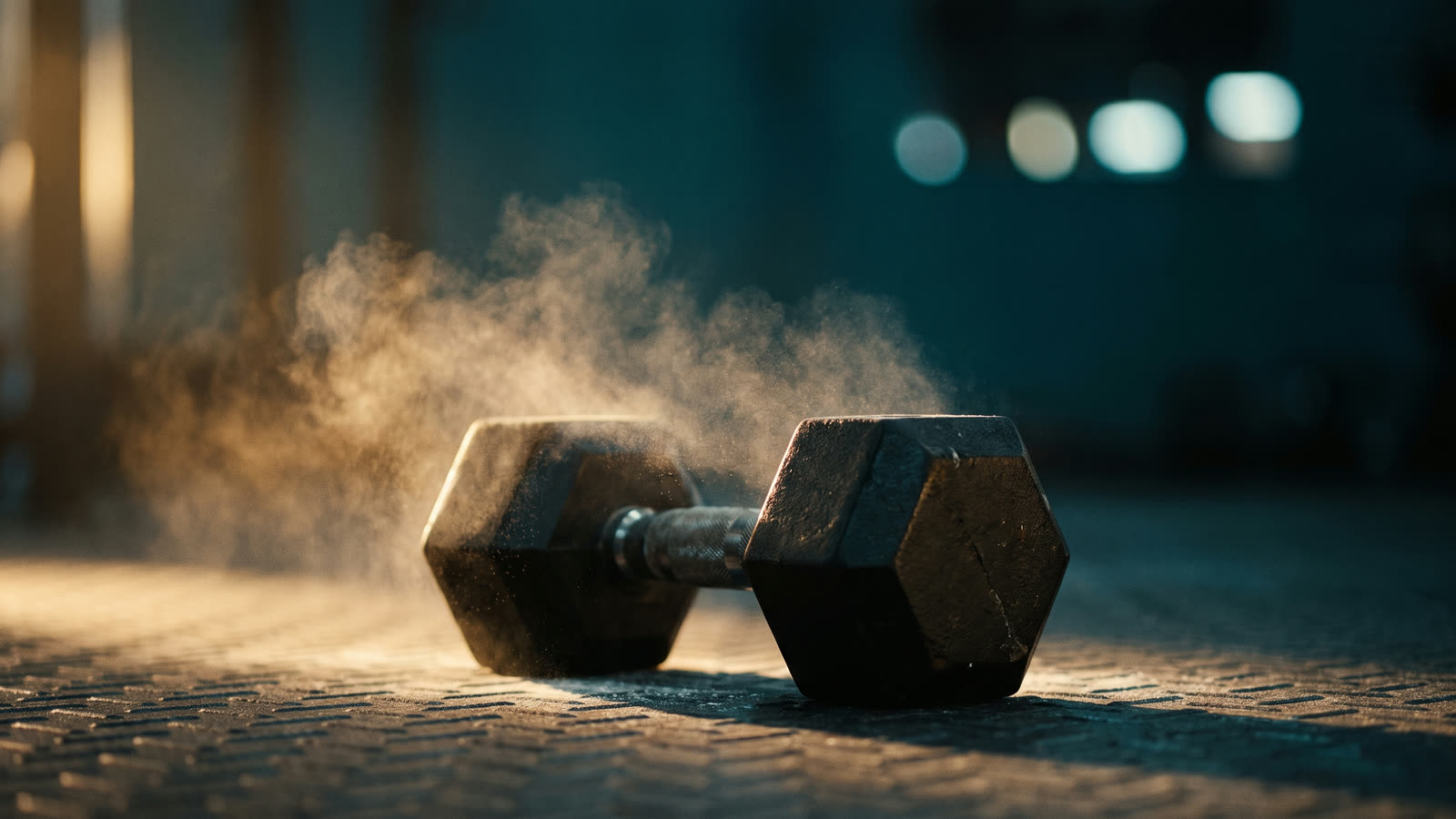
A sumo squat is a squat with your feet set wide and your toes turned out, so you sit straight down between your heels. At home it's usually done with a dumbbell or a kettlebell hanging between your legs; in a gym, often with a barbell on your back. It isn't the sumo deadlift, which pulls a bar up from the floor with your hands inside your knees. That one is on deadlift form.
This page covers the setup, the dumbbell, kettlebell and barbell versions, what the studies found a wide stance changes for the glutes and the inner thighs, the faults, and the sets. The standard squat, and how deep to go, are on squat form; the version with the weight held at your chest is the goblet squat.
How to do a sumo squat
- Stand wide, feet well outside your shoulders. Two of the barbell studies below put their wide stances at about 1.7 times shoulder width1 and 1.4 times;2 use the widest stance where your knees can still follow your toes.
- Turn your toes out. In 39 lifters filmed at a national powerlifting championship, the wide-stance squatters turned their feet out about 6 degrees more than the narrow-stance ones, and their shins stayed more upright.1 Point your knees the way your toes point.
- Hold the weight: a dumbbell held upright by its top end, or a kettlebell by the handle, arms long, the weight hanging between your legs.
- Sit straight down between your heels, chest up, knees pushing out over your toes, as deep as you can go with your heels down and your back holding its position.
- Stand up by pushing the floor away, and finish with your hips straight at the top.
The powerlifting study found no significant difference in trunk position between the stances,1 so that study found no sign a wide stance by itself makes you stand more upright; holding the weight close and your chest up does that part.
Dumbbell, kettlebell or barbell
| Version | How | When to use it |
|---|---|---|
| Dumbbell | Held upright by one end, hanging between your legs | The standard home version |
| Kettlebell | Held by the handle, hanging between your legs | The same; stand on two low plates or blocks if the bell touches the floor before you reach depth |
| Barbell | On your upper back, as in a back squat | Heavier loads; it's the version the stance studies tested |
| Weight at the chest | One dumbbell or kettlebell held against your chest | The goblet squat with a wider stance |
| Bodyweight | Hands clasped in front of you | Learning the stance; small pulses at the bottom are one variation |
Sumo squat vs goblet squat: the goblet squat holds the weight at your chest with your feet a little wider than your shoulders; the sumo squat widens the stance and usually lets the weight hang. They're the same squat with a different stance and a different place for the load. One caution on the evidence: every stance-width study on this page used a barbell on the back. None tested a dumbbell between the legs, so read the findings below as what a wide stance does in a squat, not as a test of the dumbbell version.
What a wide stance changes
A sumo squat works the same muscles as any squat: the front of the thighs, the glutes and the inner thighs. The stance moves the share between them. The studies, all of muscle activity or modeled force rather than growth:
- The glutes: three studies found more with a wide stance. In six experienced lifters, the glutes were the one muscle of eight measured that worked harder at the widest stance (with no load and at 70% of their max); the other seven showed no significant difference.3 In 18 recreationally trained lifters, nine men and nine women, a low bar with a wide stance put more of the work on the hips, while a high bar with a narrow stance put more on the knees, with more front-thigh and less glute activity.4 In two experiments with 70 and 20 male lifters, a computer model estimated more glute and hamstring force with a wide stance, and the second found more quadriceps force with a narrow one.5
- The inner thighs: more, especially with the toes turned out. In 10 male competitive bodybuilders at 80% of their max, a back squat with twice the usual stance produced more activity on the way up in the adductor longus, an inner-thigh muscle, and in the outer quadriceps than a front squat did; with the toes also turned out, adductor activity was higher than in the regular-stance back squats as well.6 In nine male lifters squatting at 75%, 100% and 140% of shoulder width, stance changed inner-thigh and glute activity but didn't isolate any part of the quadriceps.2
- Not the top inner-thigh exercise. In 24 physically active college students, the sumo squat came last in the authors' ranking of adductor longus activity across six exercises aimed at the inner thigh; lying on your side and lifting the bottom leg produced more than any other.7
- Not every study agrees. In 18 people, 12 men and six women, from recreational lifters to competitive powerlifters, a stance twice the width of the hips raised activity in one front-thigh muscle, the vastus medialis, and had no significant effect on the glutes; overall, no combination of stance, bar position and load stood out.8
Growth is the gap. No trial that trained one group with a wide stance and another with a narrow one, and measured muscle size, turned up in a PubMed search for this page. Depth has that trial: in 17 men over ten weeks, full squats grew the inner thighs and glutes more than half squats, 6.2% against 2.7% and 6.7% against 2.2%.9 So, as squat form puts it, a squat for the glutes is a deep squat first and a wide one second. For sumo squats for glutes, the one growth trial is about depth, and the stance results are mixed, so go as deep as your knees and back allow.
The common faults, and a fix for each
- Knees caving in. Push them out over your toes on the way down and up. If they won't stay there, bring your feet in a little.
- A stance wider than your hips allow. When the knees can't follow the toes, depth disappears. Narrow the stance until both work.
- Feet rolling in or heels lifting. Keep your whole foot on the floor; turn the toes out a touch more if the heels come up.
- The weight pulling you forward. Hold it close, arms straight down, chest up. A bell too heavy to hold close is the cue to move to a barbell.
- Cutting the depth. Go as deep as your heels and your back position allow; the depth trial above is the growth evidence.
- Squatting through something that hurts. Sore the next day is normal; a sharp or lasting hurt in the hip or the knee isn't. Stop, and see a doctor or a physical therapist.
Sets, reps and where it goes
- As the main squat at home, three sets of 8 to 15 with the heaviest dumbbell or kettlebell you have, stopping one or two reps short. (How to judge reps left.)
- As a second leg exercise after a barbell squat or the leg press, two or three sets of 10 to 15. The American College of Sports Medicine's 2026 position stand, which covers healthy adults, advises at least two sets per exercise.10
- In a full-body session, pair it with an upper-body exercise, such as the chest press machine or the rear delt fly: one set of each, so your legs rest while your upper body works.
- When 15 reps come easy and there's no heavier bell, slow the way down or pause at the bottom before you look for more weight. (Progressive overload covers the options.)
If you'd rather not plan it alone
A sumo squat is easy to learn; deciding whether it should be your main squat or your second leg exercise, and how it fits around the rest of your week, is the part a page can't do. Coaching is the version where your workouts are built around the days you actually have, and a weekly call looks at the week you just had and rebuilds the next one. Coaching to build muscle explains how that works, and here's how to apply. Otherwise: at your next leg session, try three sets of sumo squats at a stance where your knees follow your toes, and write down the weight.
General education only, not medical advice. If you have a medical condition, are pregnant, or take medication, check with your doctor before changing how you train or eat.
Sources
- Escamilla RF, Fleisig GS, Lowry TM, et al. A three-dimensional biomechanical analysis of the squat during varying stance widths. Medicine & Science in Sports & Exercise, 2001. https://pubmed.ncbi.nlm.nih.gov/11404665/ (accessed October 24, 2026).
- McCaw ST, Melrose DR. Stance width and bar load effects on leg muscle activity during the parallel squat. Medicine & Science in Sports & Exercise, 1999. https://pubmed.ncbi.nlm.nih.gov/10188748/ (accessed October 24, 2026).
- Paoli A, Marcolin G, Petrone N. The effect of stance width on the electromyographical activity of eight superficial thigh muscles during back squat with different bar loads. Journal of Strength and Conditioning Research, 2009. https://pubmed.ncbi.nlm.nih.gov/19130646/ (accessed October 24, 2026).
- Larsen S, Kristiansen E, Helms E, van den Tillaar R. Effects of stance width and barbell placement on kinematics, kinetics, and myoelectric activity in back squats. Frontiers in Sports and Active Living, 2021. https://pmc.ncbi.nlm.nih.gov/articles/PMC8440835/ (accessed October 22, 2026).
- Sinclair J, Taylor PJ, Jones B, et al. A multi-experiment investigation of the effects stance width on the biomechanics of the barbell squat. Sports, 2022. https://pmc.ncbi.nlm.nih.gov/articles/PMC9503729/ (accessed October 24, 2026).
- Coratella G, Tornatore G, Caccavale F, et al. The activation of gluteal, thigh, and lower back muscles in different squat variations performed by competitive bodybuilders: implications for resistance training. International Journal of Environmental Research and Public Health, 2021. https://pubmed.ncbi.nlm.nih.gov/33477561/ (accessed October 24, 2026).
- Delmore RJ, Laudner KG, Torry MR. Adductor longus activation during common hip exercises. Journal of Sport Rehabilitation, 2014. https://pubmed.ncbi.nlm.nih.gov/23945760/ (accessed October 24, 2026).
- Lee CXY, Crossman AJ, Kedgley AE. The effects of bar positioning, stance width, repetition, and load on muscle activity during the barbell back squat. PLOS ONE, 2026. https://pmc.ncbi.nlm.nih.gov/articles/PMC13460602/ (accessed October 24, 2026).
- Kubo K, Ikebukuro T, Yata H. Effects of squat training with different depths on lower limb muscle volumes. European Journal of Applied Physiology, 2019. https://pubmed.ncbi.nlm.nih.gov/31230110/ (accessed October 22, 2026).
- Currier BS, D'Souza AC, Singh MAF, et al. American College of Sports Medicine position stand. Resistance training prescription for muscle function, hypertrophy, and physical performance in healthy adults: an overview of reviews. Medicine & Science in Sports & Exercise, 2026. https://pmc.ncbi.nlm.nih.gov/articles/PMC12965823/ (accessed October 11, 2026).