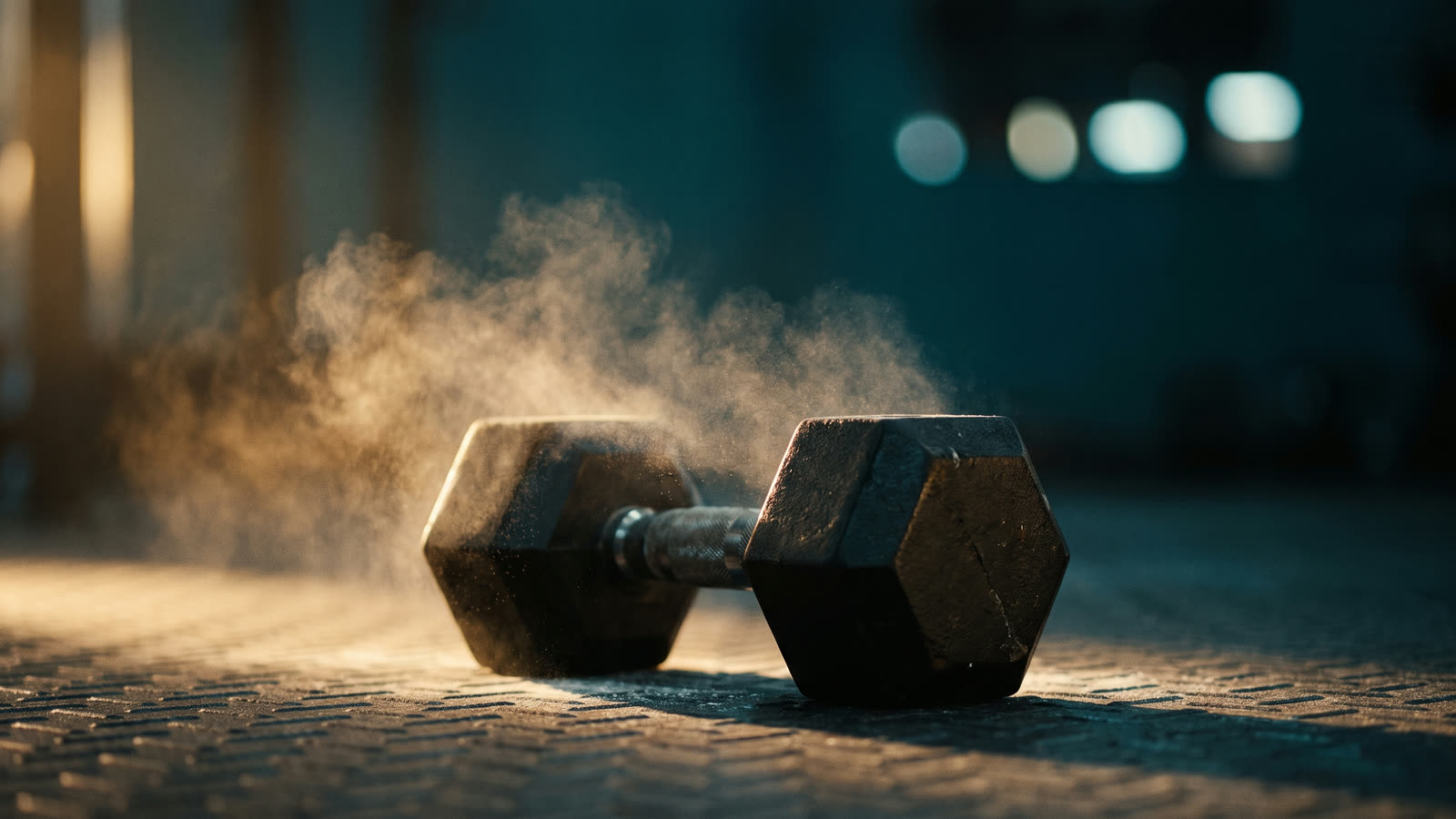
"Toned" isn't a measurement. Studies of training measure muscle size, strength and body fat, not tone. When people say they want to look toned, they usually mean two things at once: enough muscle that you can see its shape, and little enough fat over it that it shows. So getting toned is building some muscle and, if you need to, losing some fat. Each half has its own page on this site; this one puts them together and clears up the two myths that get in the way.
It's a page about how the look is built, not a promise about how your body will change or when. The studies below measured groups of people.
1. Build some muscle
This is the half most toning plans leave out. Muscle grows from hard sets, done often enough, with a little more asked of them over time. The American College of Sports Medicine's 2026 position stand, an overview of 137 systematic reviews, found that 10 or more sets per muscle group a week enhanced muscle growth.1 The short list, piece by piece: how to build muscle. If you've never lifted: how to start lifting weights.
2. Skip the "light weights, high reps" rule
The old advice is light weights and lots of reps to tone, heavy weights to bulk. The research doesn't split it that way. A 2017 review of 21 studies found that light and heavy loads built similar muscle when sets were taken to failure, with heavy loads better for one-rep-max strength.2 What matters is that the set gets hard, whatever the weight. Light sets that never get hard build little. The ranges in detail: how many reps.
3. Lose some fat, if there's fat to lose
If the muscle is there and you can't see it, the other half is fat. That comes off the whole body with a small calorie deficit, and lifting through it is what keeps the muscle you've built: a review found that diet-induced weight loss reduces muscle mass and that resistance exercise helps preserve it.3 The method, step by step: how to lose body fat. Protein holds both halves together: this site's number for people who lift is 0.7 to 1 gram per pound of bodyweight a day, about 1.6 to 2.2 grams per kilogram (calories and protein).4,5
4. Toned arms, legs or abs: pick the muscle, not the fat
You can choose which muscles you train. You can't choose where the fat comes off. In a 2007 study of 104 adults who trained only one arm, MRI found fat loss spread across both arms rather than concentrated in the trained one.6 In a 2013 trial of 11 young adults who trained only one leg, the fat that came off was in the arms and trunk, not in the trained leg.7 So train the part you care about for the muscle, and lose the fat over it with the rest of your body:
- Arms: the arm workout, with the presses and rows from your main sessions.
- Legs and glutes: the leg day workout and the glute workout.
- Abs: how to get a six pack, and how to lose belly fat for the trials of training one spot.
5. For women: the same training
Toning is often sold to women as a different kind of workout. The studies don't support a different kind. In a 2025 analysis of 29 studies that put healthy men and women aged 18 to 45 on the same program, muscle growth as a percentage of starting size was similar between the sexes.8 The worry about getting bulky is answered, with the study's limits, on the coaching page for women, and the week itself is on strength training for women.
Common questions
How do you get toned fast?
There's no honest timeline. How long it takes depends on how much muscle you're starting with and how much fat sits over it, and nobody can see that from a page. What you control is hard sets every week and a log to show they're getting heavier.
Can you tone your body at home without equipment?
Yes. In the 2017 review, light and heavy loads built similar muscle when every set was taken to failure.2 That's the case for training with what you have, as long as the sets get hard: the bodyweight workout, or the resistance band workout if you have bands.
How do you tone your body without losing weight?
By building muscle while you lose some fat, which is called body recomposition. The scale may barely move while your shape, your waist and your lifts change: body recomposition.
Does Pilates tone your body?
"Toning" isn't something the Pilates studies measured either. What they measured was strength and balance, and the comparison with weights is on Pilates vs weight training.
How do you get toned arms as a woman?
The same way as anyone: train the arms with sets that get hard, alongside your presses and rows, and lose fat across your body if you need to. In the one-arm study, fat loss wasn't concentrated in the trained arm by MRI, in men or women.6 The sessions: the arm workout.
If you'd rather have it built for you
Both halves are simple on paper; doing them together, week after week, and knowing which one to push when nothing seems to change, is the hard part. Coaching is the version where your workouts live in Trainerize, built around the days you actually have, and a weekly call looks at the week you just had and rebuilds the next one. Coaching to build muscle and coaching for women explain how that works, and apply is the first step. Otherwise: pick three exercises and take each set within a rep or two of failure this week.
General education only, not medical advice. If you have a medical condition, are pregnant, or take medication, check with your doctor before changing how you train or eat.
Sources
- Currier BS, D'Souza AC, Singh MAF, et al. American College of Sports Medicine position stand. Resistance training prescription for muscle function, hypertrophy, and physical performance in healthy adults: an overview of reviews. Medicine & Science in Sports & Exercise, 2026. https://pmc.ncbi.nlm.nih.gov/articles/PMC12965823/ (accessed October 11, 2026).
- Schoenfeld BJ, Grgic J, Ogborn D, Krieger JW. Strength and hypertrophy adaptations between low- vs. high-load resistance training: a systematic review and meta-analysis. Journal of Strength and Conditioning Research, 2017. https://pubmed.ncbi.nlm.nih.gov/28834797/ (accessed October 12, 2026).
- Cava E, Yeat NC, Mittendorfer B. Preserving healthy muscle during weight loss. Advances in Nutrition, 2017. https://pmc.ncbi.nlm.nih.gov/articles/PMC5421125/ (accessed October 11, 2026).
- Morton RW, Murphy KT, McKellar SR, et al. A systematic review, meta-analysis and meta-regression of the effect of protein supplementation on resistance training-induced gains in muscle mass and strength in healthy adults. British Journal of Sports Medicine, 2018. https://pmc.ncbi.nlm.nih.gov/articles/PMC5867436/ (accessed October 11, 2026).
- Jäger R, Kerksick CM, Campbell BI, et al. International Society of Sports Nutrition position stand: protein and exercise. Journal of the International Society of Sports Nutrition, 2017. https://pmc.ncbi.nlm.nih.gov/articles/PMC5477153/ (accessed October 11, 2026).
- Kostek MA, Pescatello LS, Seip RL, et al. Subcutaneous fat alterations resulting from an upper-body resistance training program. Medicine & Science in Sports & Exercise, 2007. https://pubmed.ncbi.nlm.nih.gov/17596787/ (accessed October 30, 2026).
- Ramírez-Campillo R, Andrade DC, Campos-Jara C, et al. Regional fat changes induced by localized muscle endurance resistance training. Journal of Strength and Conditioning Research, 2013. https://pubmed.ncbi.nlm.nih.gov/23222084/ (accessed October 30, 2026).
- Refalo MC, Nuckols G, Galpin AJ, et al. Sex differences in absolute and relative changes in muscle size following resistance training in healthy adults: a systematic review with Bayesian meta-analysis. PeerJ, 2025. https://pmc.ncbi.nlm.nih.gov/articles/PMC11869894/ (accessed October 24, 2026).