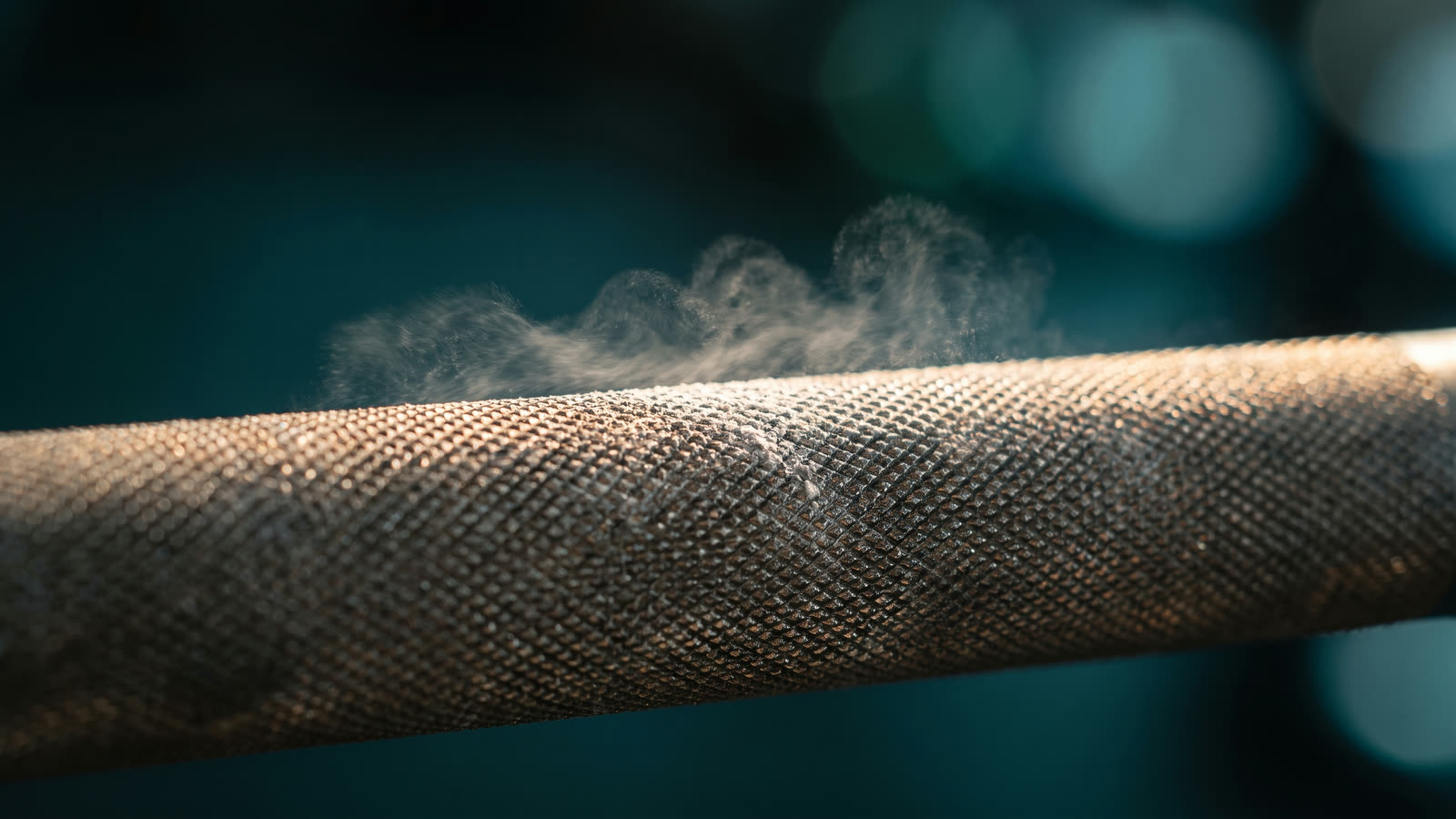
The clean and jerk is a two-part barbell lift. In the clean, you pull the bar from the floor and catch it on the front of your shoulders, then stand up. In the jerk, you dip your knees, drive the bar up with your legs, and drop under it to catch it overhead on straight arms. It's one of the two lifts in weightlifting: in competitions, the final rank is based on the total of the heaviest successful snatch and the heaviest successful clean and jerk.1
It's one of the most technical lifts on this site. This page describes the positions and what the studies measured; it's learned with a weightlifting coach watching you lift. The clean half has its own pages, the power clean and the hang clean, and the dip and drive is the same one used in the push press.
How to do it, position by position
The clean
- Set up with the bar over the middle of your feet, hands just outside your legs, back flat, hips above your knees.
- Pull the bar to above your knees, then extend your hips, knees and ankles fast as it reaches your thighs.
- Drop under and catch it on the front of your shoulders, elbows high, in a full front squat (or a quarter squat for a power clean). Stand up.
The jerk
- Reset. Take a breath, feet about hip width, the bar resting on your shoulders, elbows a little in front of the bar.
- Dip. Bend your knees a short way, torso upright, weight through your whole foot.
- Drive. Straighten your legs hard so the bar leaves your shoulders. A 2019 review of these overhead lifts says they need high forces developed rapidly, by an impulsive extension of the hips, knees and ankles.2
- Drop under. Push yourself down as the bar rises and catch it on locked arms, the bar over the back of your neck.
- Recover. In a split jerk, step the front foot back a little, then the back foot forward, until your feet are together under the bar. Then lower it.
A study of the jerk divides it into six stages: preparation, the pre-squat (the dip and its braking), the drive, the bar's rise, the squat under it, and standing up.1
Split, push and squat jerk
- Split jerk: as you drop under the bar, one foot steps forward and the other back. The study of elite lifters describes the catch in this style as a front-back stance like an archer's. The earlier work the study reviews credits this style with a larger stable angle in the catch and better support of the bar.1
- Push jerk: the feet stay side by side; after the drive you bend your knees a second time and catch the bar overhead in a partial squat. The push press is the same drive without that second dip.
- Squat jerk: the lifter catches the bar in a deep squat. The same paper describes the support in this style as relying on actively bending the knees and hips at the end of the drive, and notes that relatively few athletes use the squat jerk in international competition.1
How they compare in numbers: in 15 men and 15 women with weightlifting experience, the push press max averaged about 1.0 times body weight in the men, the push jerk 1.1 and the split jerk 1.2; in the women, 0.8, 0.9 and 0.9.3 At the same load, 80% of their push press max, 16 resistance-trained lifters applied no significantly different force, power or impulse across the push press, the push jerk and the split jerk.4 In both groups the push press max was the lowest of the three, and the two jerks were close to each other.
What the studies of the lift measured
- Split against squat jerk. In 52 attempts by 32 male weightlifters, filmed and analysed in three dimensions, the two styles were essentially the same through the dip, the drive and the bar's rise. They differed in the squat under the bar and the support position, including how stable the catch stance was.1
- Rest between heavy attempts. Nine elite weightlifters did two maximal clean and jerks in each of two sessions, once with two minutes between them and once with three. The extra minute reduced the drop in bar height, bar speed and knee and hip extension during the jerk's drive. The authors suggest three minutes between maximal attempts.5
- The trunk. In 21 fit male students doing a clean and jerk with a barbell, a sandbag and a water bag of the same weight, activity in the front of the shoulder didn't differ. The water bag version produced more activity in the obliques, the side glutes and the lower back muscles than the other two.6 That's activity in one session, not a change over weeks.
The 2019 review found only 13 articles on these overhead lifts and noted a lack of information about their longer-term training effects.2 So the clean and jerk is a well-described competition lift, not one with trials showing what weeks of it build for a non-lifter.
How to build up to it
As a practical order, learn each piece on its own before you join them:
- The front squat, for the rack position and the catch of the clean.
- The hang power clean, for the jump and the turnover.
- The push press, for the dip and drive.
- The push jerk or the split jerk from the rack, with an empty bar, for the drop under.
- The power clean from the floor, then the two halves together.
The common faults, and a fix for each
- A long, slow dip. The bar loses the drive the legs gave it. Keep the dip short and change direction fast.
- Pressing it out. Bending and re-straightening the arms overhead means you didn't get under it in time. Drop faster, or go lighter.
- The dip tipping forward. If your chest drops, the bar drives out in front. Stay upright with your weight across the whole foot.
- A short split. Feet too close front to back make the catch unstable. Practise the split position without a bar.
- Rushing the jerk. After the clean, take a breath and set your feet and elbows before you dip.
- Lifting through something that hurts. If you have pain, an injury or a condition, ask a doctor or a physical therapist.
Sets, reps and rest
- From the study of nine elite lifters: three minutes between two attempts at their max kept the jerk technique better than two minutes did.5 That is one small study at maximal loads, not a rule for practice sets.
- A practical start: singles and doubles. Three to five sets of one or two reps with an empty or light bar, full rest, first in the session after a warm-up.
- Once or twice a week is plenty; the clean shares your legs with squats and the jerk shares your shoulders with presses.
Common questions
Clean and jerk or snatch?
Both are the competition lifts, and the total of the heaviest successful lift in each decides the rank.1 The snatch takes the bar from the floor to overhead in one movement with a wide grip; the clean and jerk stops at the shoulders first. The overhead squat at the bottom of the snatch is on the overhead squat.
Clean and jerk or clean and press?
The press keeps the legs straight and uses only the arms and shoulders to take the bar overhead, like the overhead press; the jerk uses a leg drive and a drop under the bar. As a practical difference, the press is the easier one to learn and the jerk lets you put more weight overhead.
Can I do it with dumbbells or kettlebells?
Yes, as a practical option: clean the weights to your shoulders and jerk them. With kettlebells, a clean and a jerk done again and again for 10 minutes is a competition event of its own;7 the kettlebell clean covers it.
What if something hurts?
If you have pain, an injury or a medical condition, a doctor or a physical therapist should set the limits before you train hard.
If you'd rather not plan it alone
This page describes a competition lift; it isn't a sign that coaching will program it for you, and it's learned with a weightlifting coach watching you lift. What coaching does is build the week around your goals and your days: your workouts live in Trainerize, sized to the time you have, and a weekly call looks at the week you just had and rebuilds the next one. Coaching explains how that works, and here's how to apply. Otherwise: at your next session, after a warm-up, do three sets of three push presses with an empty bar and write down how the dip felt.
General education only, not medical advice. If you have a medical condition, are pregnant, or take medication, check with your doctor before changing how you train or eat.
Sources
- Liu G, He Z, Ye B, et al. Comparative Analysis of the Kinematic Characteristics of Lunge-Style and Squat-Style Jerk Techniques in Elite Weightlifters. Life, 2024. https://pmc.ncbi.nlm.nih.gov/articles/PMC11433488/ (accessed October 29, 2026).
- Soriano MA, Suchomel TJ, Comfort P. Weightlifting Overhead Pressing Derivatives: A Review of the Literature. Sports Medicine, 2019. https://pubmed.ncbi.nlm.nih.gov/30924081/ (accessed October 26, 2026).
- Soriano MA, García-Ramos A, Calderbank J, et al. Does Sex Impact the Differences and Relationships in the One Repetition Maximum Performance Across Weightlifting Overhead Pressing Exercises? Journal of Strength and Conditioning Research, 2022. https://pubmed.ncbi.nlm.nih.gov/32732776/ (accessed October 26, 2026).
- Soriano MA, Lake J, Comfort P, et al. No differences in weightlifting overhead pressing exercises kinetics. Sports Biomechanics, 2024. https://pubmed.ncbi.nlm.nih.gov/34704894/ (accessed October 26, 2026).
- Ammar A, Riemann BL, Trabelsi K, et al. Comparison of 2- and 3-Minute Inter-Repetition Rest Periods on Maximal Jerk Technique and Power Maintenance. Research Quarterly for Exercise and Sport, 2019. https://pubmed.ncbi.nlm.nih.gov/30990367/ (accessed October 29, 2026).
- Calatayud J, Colado JC, Martin F, et al. Core muscle activity during the clean and jerk lift with barbell versus sandbags and water bags. International Journal of Sports Physical Therapy, 2015. https://pmc.ncbi.nlm.nih.gov/articles/PMC4637915/ (accessed October 29, 2026).
- László S, Hortobágyi T, Sebesi B, et al. Physiological characterization of a simulated kettlebell routine in experienced kettlebell athletes. Physiology International, 2024. https://doi.org/10.1556/2060.2024.00383 (accessed October 29, 2026).