
The CDC reports the share of U.S. adults who do muscle-strengthening activities on two or more days a week, from its Behavioral Risk Factor Surveillance System. Two days is the line because it's the guideline: the WHO asks adults to do muscle-strengthening activity on 2 or more days a week.1 This page puts the national answers in one table, by age group and by sex, with the confidence interval and the number of people asked for each.
The table: 2023, by age and sex
Each figure is a survey estimate from the CDC's Behavioral Risk Factor Surveillance System, in the dataset's national (U.S.) rows.2 The range in brackets is the 95% confidence interval the CDC publishes; where two groups' ranges overlap, the difference between them may not be meaningful.
| Group | Muscle-strengthening 2+ days a week (95% CI) | Adults asked |
|---|---|---|
| All adults | 41.0% (40.6–41.3) | 411,023 |
| Age 18 to 24 | 51.2% (50.1–52.3) | 25,117 |
| Age 25 to 34 | 43.3% (42.5–44.2) | 44,078 |
| Age 35 to 44 | 40.7% (39.8–41.5) | 53,807 |
| Age 45 to 54 | 38.3% (37.4–39.1) | 58,794 |
| Age 55 to 64 | 37.5% (36.7–38.4) | 73,971 |
| Age 65 and older | 38.1% (37.5–38.7) | 155,256 |
| Men | 45.1% (44.7–45.6) | 194,231 |
| Women | 37.0% (36.5–37.5) | 216,792 |
Download this table (CSV). Free to reuse with a link back to this page.
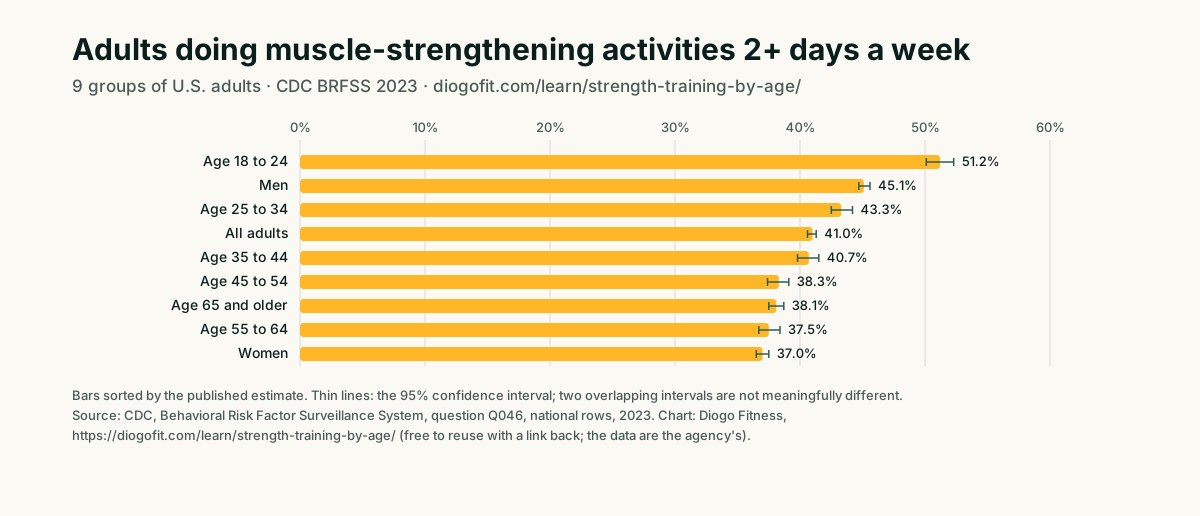
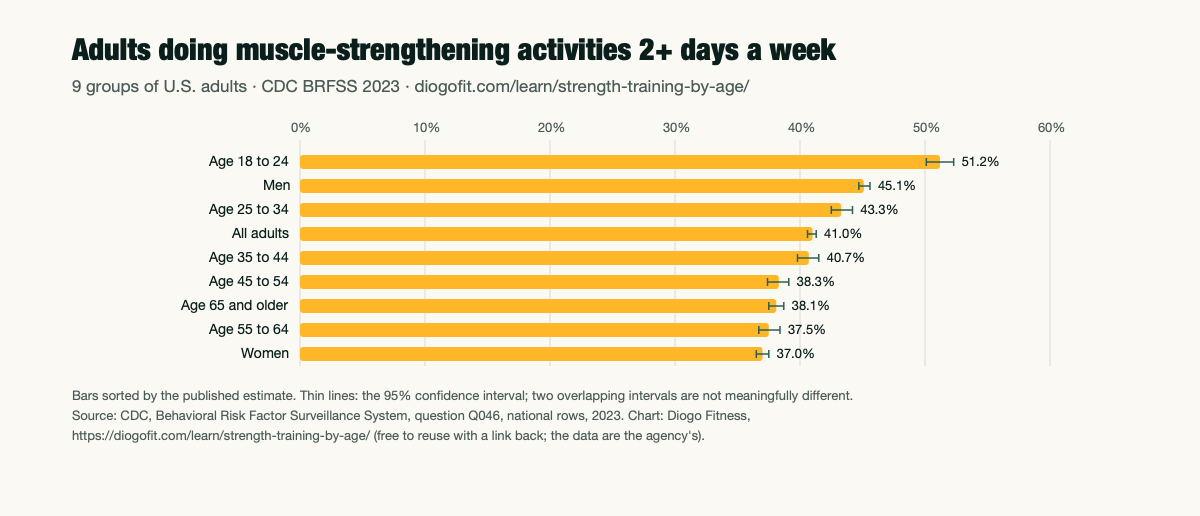
Download the table as a CSV from the link under it. Source: CDC, Nutrition, Physical Activity, and Obesity, Behavioral Risk Factor Surveillance System, question Q046, 2023, national rows.2 The dataset is in the public domain.
What the numbers show
- Fewer than half of adults report it. 41.0% of adults said they strength-train on two or more days a week in 2023.2
- The youngest group reports it most. 51.2% at 18 to 24, against 37.5% to 38.3% between 45 and 64.2
- It doesn't keep falling after 55. The 65-and-older group (38.1%) sits at about the same level as 45 to 64.2
- Men report it more than women, 45.1% against 37.0%.2
These are self-reported answers, not measured training. They tell you how common the habit is, not how hard or how well anyone trains.
The national figure over time
| Survey year | All adults, muscle-strengthening 2+ days a week (%) | 95% confidence interval |
|---|---|---|
| 2011 | 29.3 | 29.1 to 29.6 |
| 2013 | 29.6 | 29.3 to 29.9 |
| 2015 | 30.4 | 30.1 to 30.7 |
| 2017 | 30.5 | 30.2 to 30.8 |
| 2019 | 35.3 | 35.0 to 35.6 |
| 2023 | 41.0 | 40.6 to 41.3 |
These are the national estimates as the CDC publishes them in the same dataset, which has national rows for 2011, 2013, 2015, 2017, 2019 and 2023.2 This page reports each year's figure and doesn't explain the change between them.
How to cite this table
Cite the CDC as the source of the data: Centers for Disease Control and Prevention, Behavioral Risk Factor Surveillance System, via the Nutrition, Physical Activity, and Obesity dataset on data.cdc.gov, question Q046.2 If this page saved you the work of pulling it, a link back is welcome. The state-by-state version is how active is your state, and every data table on the site is on the data page.
Common questions
What percentage of adults strength train?
In the CDC's 2023 survey, 41.0% of U.S. adults said they do muscle-strengthening activities on 2 or more days a week.2
How many women lift weights?
37.0% of women in the 2023 survey reported muscle-strengthening activities on 2 or more days a week, against 45.1% of men.2 The question covers any muscle-strengthening activity, not only weights. Strength training for women covers how to start.
Do older adults strength train less?
Less than 18- to 24-year-olds, but about the same as ages 45 to 64: 38.1% at 65 and older, against 38.3% at 45 to 54 and 37.5% at 55 to 64.2 Workouts for seniors covers the guideline for older adults.
If you'd rather be in the 41%
Two days a week is the line in the table. How often to train covers the schedule. If you want the plan built around you, coaching explains how it works, and apply tells me where you're starting.
General education only, not medical advice. If you have a medical condition, are pregnant, or take medication, check with your doctor before changing how you train or eat.
Sources
- Bull FC, Al-Ansari SS, Biddle S, et al. World Health Organization 2020 guidelines on physical activity and sedentary behaviour. British Journal of Sports Medicine, 2020. https://pmc.ncbi.nlm.nih.gov/articles/PMC7719906/ (accessed October 11, 2026).
- Centers for Disease Control and Prevention, Division of Nutrition, Physical Activity, and Obesity. Nutrition, Physical Activity, and Obesity: Behavioral Risk Factor Surveillance System (dataset hn4x-zwk7), question Q046 (muscle-strengthening activities on 2 or more days a week), national (US) rows, 2011–2023, total, age and sex. CDC, data.cdc.gov (public domain), 2026. https://data.cdc.gov/Nutrition-Physical-Activity-and-Obesity/Nutrition-Physical-Activity-and-Obesity-Behavioral/hn4x-zwk7 (accessed October 31, 2026).